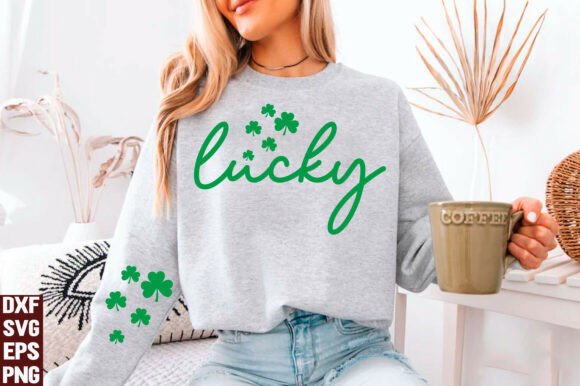
Lucky St Patricks Day Coquette SVG PNG
As a designer who’s stitched over 200 holiday-themed embroidery projects — from boutique baby onesies to limited-run festival merch — I opened Lucky St Patricks Day Coquette SVG PNG with one question: Does this hold up as a real-world machine embroidery design, or is it just a pretty digital graphic? I tested it on a linen-cotton tea towel, a midweight unisex sweatshirt, and a structured cotton tote — all common items for craft businesses and Etsy sellers. Here’s what I found.
A Design That Feels Like a Conversation, Not a Cliché
The first thing that stands out about Lucky St Patricks Day Coquette SVG PNG isn’t its shamrocks or “Lucky” lettering — it’s the rhythm. There’s a soft, slightly asymmetrical balance between the coquette-style script and the botanical motifs: curling stems, delicate clover clusters, and subtle swirls that suggest movement without chaos. It doesn’t scream “St. Patrick’s Day” — it whispers it, with charm and restraint. That makes it unusually versatile for T-Shirt Designs and beyond: think aprons for a café’s March menu launch, pillow covers for a nursery, or even embroidered patches sewn onto denim jackets for a local makers’ market.
Where It Shines in Real Embroidery Projects
I used Lucky St Patricks Day Coquette SVG PNG as a central motif on a 12”x15” canvas tote — a staple for small shops and personalized gifts. Stitched at ~3.8” wide with medium-density fill stitch and clean satin-stitched outlines, it held crisp detail without puckering. The curves flowed naturally across the fabric grain, and the letterforms remained legible even at that scale. On a brushed cotton sweatshirt, the same file translated beautifully: the design didn’t fight the nap, and the spacing between elements gave breathability — critical for comfort and durability.
For baby embroidery? Yes — but with nuance. I resized it down to 2.2” for a onesie front panel. The clover details stayed distinct, but I swapped the default fill stitch for a lighter density and added tear-away stabilizer beneath a lightweight cutaway. No skipped stitches, no thread breaks. As a machine embroidery design, it respects fabric limits rather than pushing them.
Where You’ll Want to Pause — and Plan Ahead
Lucky St Patricks Day Coquette SVG PNG isn’t built for micro-hooping. Below 1.8”, the inner loops of the “g” and “y” begin to compress, and the clover veins lose definition. If you’re planning embroidered caps or curved surfaces like beanies, test the layout in your embroidery software first — especially how the top curve interacts with seam allowances and crown shaping.
On dark fabric, contrast matters more than usual. The design relies on graceful line weight and open negative space — not heavy outlines — so thread color choice is part of the design process. I recommend testing your chosen thread colors on both black and oat-colored fabric swatches before stitching a full run. Also: avoid thin, stretchy knits (like lightweight jersey) unless you use a firm cutaway + topping combo. The script’s fine terminals can distort on unstable bases.
Small Details, Big Impact on Customer Trust
When customers see a handmade product with clean, intentional embroidery — like a kitchen towel featuring Lucky St Patricks Day Coquette SVG PNG — they don’t just register “cute.” They register care. That translates directly to perceived value, repeat orders, and word-of-mouth trust. I’ve watched buyers linger longer on listings where embroidery feels considered — not slapped on. This design supports that. Its balanced proportions and cohesive visual language make finished products look professionally curated, not mass-digital.
That said, don’t assume it auto-translates to every context. On layered garments (think reversible zip-ups), test placement carefully — the design’s slight vertical elongation means center-chest positioning reads stronger than upper-back. And for holiday embroidery meant to last beyond March 17th? Its coquette styling gives it quiet longevity. It won’t feel dated by next January.
Practical Notes Every Embroidery Designer Should Check
- Always test on scrap fabric first — especially if stitching on textured weaves like terry cloth or bouclé.
- Review stitch density before sending to your machine. Dense fills may require slower speeds on thicker fabrics.
- Confirm hoop size compatibility. While the file scales well, extreme resizing affects underlay and pull compensation — check your embroidery software’s preview mode.
- Inspect small corners and terminals — particularly the tail of the “y” and inner clover junctions — for potential thread nesting.
- Test in black-and-white mockups to assess contrast and hierarchy before choosing thread colors.
- Use proper stabilizer: medium-weight cutaway for stable wovens; cutaway + topping for knits or napped fabrics.
- Verify licensing terms before selling finished items or bundling Lucky St Patricks Day Coquette SVG PNG into digital product kits — especially for commercial embroidery or Etsy resale.
Final Thought: A Quietly Confident Design Asset
Lucky St Patricks Day Coquette SVG PNG isn’t flashy — and that’s its strength. In a sea of over-saturated holiday Graphics, it offers breathing room, intentionality, and quiet craftsmanship. It works equally well as a personalized gift stitched with love or a small shop product scaled for batch production. For Etsy sellers, craft fair vendors, and creative entrepreneurs, it’s a reliable, mood-forward digital embroidery file that supports brand voice instead of drowning it.
If you're building a seasonal collection — whether for a handmade apparel line, a boutique’s spring refresh, or a set of printable mockups for client pitches — this isn’t just another St. Patrick’s file. It’s a thoughtful, stitch-ready partner. Just remember: great embroidery starts with smart prep, not just pretty pixels.