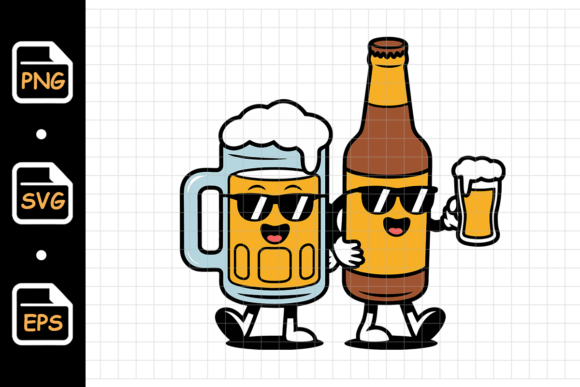
Beer Mug and Bottle Friends Cartoon
A Lighthearted, Sturdy Design—But Does It Stitch Well?
I pulled up Beer Mug and Bottle Friends Cartoon last week while prepping a batch of custom embroidered tote bags for a local brewery’s summer pop-up. Right away, the charm clicked: round mugs with cheerful faces, bottles tipped in playful camaraderie, clean outlines, and just enough detail to read at 3–4 inches wide—no visual noise, no overworked linework. It’s clearly built for illustration first, embroidery second—but that doesn’t mean it can’t hold up under needle and thread. As someone who’s stitched hundreds of cartoon-style designs across apparel, patches, and nursery items, I looked past the smiley bottle caps and asked: Will this translate cleanly when stitched? Will customers recognize the humor at a glance? And where will it actually shine—or stumble—in real production?
Where This Design Feels Like Home
Beer Mug and Bottle Friends Cartoon lands best on relaxed, personality-driven products: sweatshirt cuffs, apron pockets, baby onesies (for crafty beer-loving parents), tea towels for home bars, and embroidered patches sewn onto denim jackets or festival totes. Its balanced composition—mug on left, bottle on right, subtle shared base—gives solid visual weight without crowding. That symmetry helps with hoop alignment, especially on curved surfaces like caps or tapered pillow covers.
For Etsy sellers and small shop owners, this is a smart mid-tier design: not so literal it feels dated, not so abstract it loses its theme. It reads instantly as “beer,” but with warmth—not irony. I’ve seen similar illustrations sell well as holiday gifts (think “Cheers to 2024” baby blankets) or wedding favors (“Bride & Groom’s Brew Crew” aprons). As an embroidery file, it avoids tiny interior details—no eyelashes, no complex bottle labels—so fill stitch and satin stitch areas stay legible even at modest sizes.
Real-World Embroidery Considerations
That said, don’t rush straight to the machine. Here’s what I checked before stitching:
- Hoop size & density: The layout fits comfortably in a 4×4 hoop, but test the outer curves on scrap fabric first—especially if using textured fabrics like terry cloth or thick canvas. Dense fill areas (like mug handles or bottle bases) can puff if stabilizer isn’t matched to fabric weight.
- Fabric compatibility: Works cleanly on stable cotton, twill, and medium-weight knits—but tread carefully on thin baby rib knit or highly stretchy jersey. You’ll need cutaway stabilizer and possibly reduced stitch density to avoid distortion.
- Dark vs. light backgrounds: The transparent PNG makes mockups easy, but in real stitching, white or cream thread pops beautifully on navy or charcoal sweatshirts. On black fabric? Use matte black thread—not glossy—and double-check contrast in your digital embroidery software. Some lighter interior highlights may vanish without careful thread color planning.
- Curved surfaces & layered garments: Caps and beanies demand simplified versions. I’d simplify the bottle’s cap detail or reduce interior line weight before digitizing for headwear. Same goes for layered items like reversible pillow covers—test stitch visibility from both sides.
What This Design Adds—and What It Doesn’t Promise
Beer Mug and Bottle Friends Cartoon elevates handmade product perception because it feels intentional, not clip-art. Customers notice when a design breathes—when negative space supports shape, when proportions support readability, when the mood matches the medium. That matters for boutique branding, Etsy listings, and craft fair displays. It doesn’t scream “commercial stock,” which builds trust in a small business context.
But it’s not magic. It won’t fix poor digitizing, weak stabilizing, or mismatched thread tension. As a graphics asset, it gives you clean vectors (SVG, EPS) and crisp raster (PNG), but those files aren’t embroidery-ready out of the box—you’ll still need to digitize or convert them properly for your machine. If you’re selling finished embroidered items, confirm licensing allows commercial use. If you’re reselling the digital embroidery file itself, verify redistribution rights—those aren’t implied by file format alone.
Practical Designer Notes Before You Stitch
- Run a test stitch on scrap fabric matching your final product’s weight and texture.
- Compare black-and-white and color mockups—does the silhouette hold up without color cues?
- Check small corners and inner curves: do they stitch crisply, or do threads nest and blur?
- Use proper stabilizer—tear-away for stable wovens, cutaway for knits, and fusible for lightweight fabrics.
- Review thread color contrast on both light and dark backgrounds—not just digitally, but in person under natural light.
- If adapting for baby embroidery or holiday embroidery, consider simplifying one element (e.g., remove bottle cap shading) to improve clarity at smaller scales.
- For commercial embroidery projects, document your settings—stitch density, underlay type, trim points—so repeats stay consistent.
Final Thought: A Friendly, Flexible Asset—If Used With Intention
Beer Mug and Bottle Friends Cartoon isn’t a flashy showstopper—it’s the reliable friend you reach for when you need approachable, on-brand charm without overcomplicating your workflow. It works because it respects embroidery’s limits: no micro-details, no fragile lines, no confusing layering. It’s equally at home on a personalized gift tag or a wholesale batch of café aprons.
For embroidery designers, craft business owners, and Etsy sellers, that balance is rare. It’s not just another illustration—it’s a thoughtful starting point for real projects. Just remember: great design assets only become great finished products when paired with smart execution. Test. Adjust. Trust your eye—and your machine.