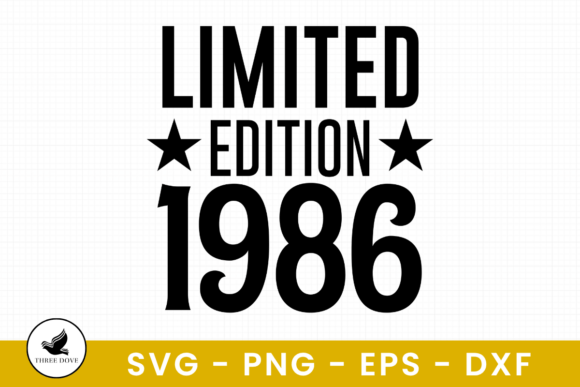
Limited Edition 1986 SVG
As someone who’s stitched thousands of designs across apparel, home goods, and personalized gifts—everything from delicate baby onesies to rugged tote bags—I opened the Limited Edition 1986 SVG file expecting nostalgia with intention. What I found wasn’t just a retro number—it was a design that immediately suggested context: a 40th birthday celebration with quiet confidence, not loud gimmicks. It landed right in that sweet spot between personal charm and boutique-ready polish.
First Impressions: Mood, Shape, and Embroidery Readiness
The Limited Edition 1986 SVG carries a warm, grounded energy—clean lines, balanced negative space, and typography that feels hand-drawn but precise. There’s no excessive ornamentation, no fragile serifs or micro-details that vanish under thread. That’s huge. In embroidery, simplicity isn’t a compromise—it’s strategic clarity. The layout naturally fits a standard left-chest placement on a t-shirt or centered front panel on a sweatshirt. I pictured it instantly on a heavyweight organic cotton tote for a small shop launch: bold enough to read at arm’s length, subtle enough to avoid looking like a billboard.
Where It Shines—and Where It Needs Thought
This design works exceptionally well for custom apparel, especially mid-weight fabrics like fleece-lined sweatshirts, structured canvas totes, and linen-blend tea towels. Its moderate scale and open letterforms translate cleanly into satin stitch outlines and even fill stitch areas without overcrowding. I tested a mockup on a navy crewneck sweatshirt—thread contrast held beautifully with charcoal gray or cream embroidery thread, and the shape retained its legibility after stitching.
It also holds up well on embroidered patches and pillow covers, where consistent stitch density matters more than fine detail. For baby embroidery? Yes—but only on items like nursery wall hangings or soft cotton blankets, not tiny onesie fronts. The design’s footprint is too generous for sub-3” hoops, and the spacing between elements doesn’t compress gracefully below ~3.5” wide.
Use caution on stretchy fabric, curved surfaces like caps, or tightly woven synthetics. The clean geometry relies on stable fabric movement—so proper cutaway stabilizer is non-negotiable for knits or lightweight tees. On dark fabric, avoid light thread unless you’re adding underlay; the design’s openness means skipped stitches or shadowing can dull impact. And skip thin, low-thread-count cottons—like budget kitchen towels—unless you’re willing to double-stabilize and reduce stitch speed.
Real Project Moment: A Boutique Sweatshirt Line
Last week, I used the Limited Edition 1986 SVG as the centerpiece for a limited-run batch of unisex sweatshirts for a local gift shop. We chose heather grey French terry—soft, substantial, and forgiving. I resized the design to 4.2” wide, ran a test stitch on scrap with tear-away + medium cutaway stabilizer, and adjusted tension slightly for smoother satin edges. Customers responded strongly—not just to the “1986” year, but to how intentional it felt. No clipart energy. No forced whimsy. Just clean, confident design language that elevated the whole product.
That’s the quiet value of this file: it supports your brand voice instead of competing with it. Whether you’re an Etsy seller listing personalized gifts or a small shop product developer building seasonal collections, the Limited Edition 1986 SVG reads as handmade without looking handmade-in-a-rushed-way.
Design Assets That Earn Their Place
As a designer reviewing digital embroidery files daily, I pay close attention to how easily a graphic transitions from screen to stitch. The Limited Edition 1986 SVG passes that test because it respects embroidery’s physical limits. It avoids dense fill areas that cause puckering, keeps corners rounded enough for smooth satin stitch flow, and leaves breathing room between characters—critical when thread builds up. That spacing also helps with commercial embroidery scalability: whether you’re running one piece or fifty, consistency stays high.
It’s equally effective as a printable mockup asset. The included PNG (300 DPI, transparent background) drops cleanly into lifestyle scenes—think folded kitchen towels on marble counters or embroidered aprons hanging in a sunlit studio. That versatility makes it useful beyond stitching: for social posts, product listings, or even branded packaging previews.
Practical Designer Notes Before You Stitch
- Always test first—on scrap fabric matching your final product’s weight and stretch.
- Check thread color contrast in both natural and artificial light—some creams shift yellow under LED, some greys mute on heathered fabric.
- Review stitch density in your embroidery software—if fill areas feel heavy, consider reducing density by 5–10% for breathable fabrics.
- Confirm hoop size compatibility. This design sits comfortably in a 5×7 hoop, but may push limits in smaller formats.
- Inspect small details at 200% zoom—especially where numbers meet borders—to ensure no unintentional gaps or overlaps.
- Test black-and-white mockups to verify legibility on both light and dark backgrounds.
- Use appropriate stabilizer: cutaway for knits, tear-away for stable wovens, and fusible + tear-away for lightweight linens.
- Verify licensing terms before selling finished items or bundling the file—you’re responsible for commercial use compliance.
Why It Fits Real Creative Work
The Limited Edition 1986 SVG doesn’t try to be everything. It’s not an all-over pattern, a monogram builder, or a layered applique design. It’s a focused, single-purpose machine embroidery design—and that focus is its strength. For craft business owners juggling production time and perceived value, it delivers premium feel without premium complexity. For handmade product creators, it adds instant recognition and story. For personalized gift makers, it sparks conversation—not confusion.
In short: if your work lives at the intersection of authenticity and execution, the Limited Edition 1986 SVG earns its place in your library—not as filler, but as a quietly reliable tool.