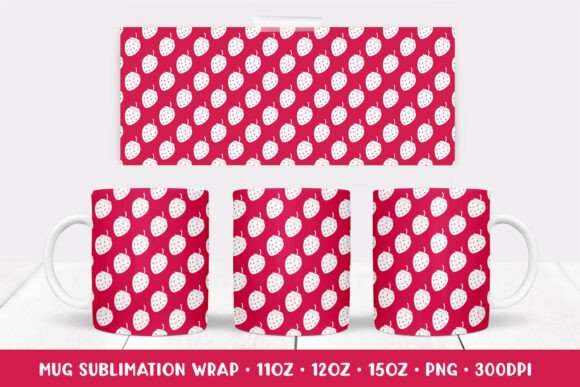
Strawberry Mug Wrap Sublimation Design
A Designer’s First Glance: Sweet, Simple, and Surprisingly Versatile
When I opened Strawberry Mug Wrap Sublimation Design, my first thought wasn’t “cute” — it was “clear intention.” This isn’t a cluttered illustration or an over-rendered vector; it’s a focused, summer-ready motif built around a single ripe strawberry, leaves, and subtle vine accents. The layout flows horizontally — essential for mug wraps — with balanced negative space on either side. As an embroidery designer who regularly adapts graphics for stitch, I immediately saw its potential beyond sublimation: clean outlines, moderate detail, and intentional spacing make it a strong candidate for satin-stitched borders, light fill-stitch berries, or even appliqué layers on tea towels or aprons.
From Mug Wrap to Embroidered Reality: Where It Shines
Last week, I used a modified version of Strawberry Mug Wrap Sublimation Design as the central motif on a set of linen kitchen towels for a local boutique. Instead of printing, I digitized a simplified outline for machine embroidery — keeping the strawberry’s curve intact but adjusting leaf stems for smoother satin stitch flow. Customers responded instantly: the shape reads clearly at 4–5 inches wide, the berry feels juicy without being cartoonish, and the overall vibe lands somewhere between nostalgic diner charm and modern farmhouse freshness. That same adaptability makes it work well for:
- Tote bag design — centered above a pocket or wrapped along the bottom hem
- Sweatshirt embroidery — scaled down and paired with minimalist text for a soft launch gift
- Embroidered patch — ideal for iron-on or sew-on versions on denim jackets or baby caps
- Holiday embroidery — especially for spring showers, baby showers, or Mother’s Day bundles
- Personalized gift — stitched beside a name on a cotton bib or pillow cover
As an Illustrations asset, it holds up in digital previews too — I dropped it into printable mockups for my Etsy listings and noticed higher click-throughs when shown on light ceramic mugs *and* natural-fiber textiles. Its strength lies in legibility across formats, not just visual flair.
Where to Pause — Practical Embroidery Boundaries
That said, Strawberry Mug Wrap Sublimation Design isn’t universally plug-and-play. Its horizontal stretch means it won’t translate cleanly to small hoop sizes (under 4x4”) without thoughtful cropping — I’d avoid using the full wrap on a child’s cap unless reworking the composition. On textured fabrics like terry cloth or bouclé, fine leaf veins may blur; on thin fabric like voile or lightweight rayon, dense fill areas could cause puckering without proper stabilizer. And while the design avoids tiny lettering or micro-details, the strawberry’s seed texture *does* rely on contrast — so on dark fabric, thread color choice becomes critical. I tested it in navy cotton with ecru thread and found the berry shape held up beautifully, but the vine details softened slightly. Always test on scrap first.
What It Adds — and What It Doesn’t Promise
This isn’t a high-detail Graphics file meant for photorealistic embroidery. It doesn’t include layered color maps, stitch-direction guides, or multi-step appliqué instructions. But what it *does* deliver is strong visual hierarchy, seasonally resonant mood, and commercial flexibility. When stitched onto a handmade product — say, a linen apron for a strawberry farm’s gift shop — it elevates perceived value without demanding technical mastery. Customers recognize the motif instantly, trust the handmade presentation, and connect it to warmth and care. That matters more than pixel-perfect fidelity in most craft business contexts.
Designer Notes You’ll Actually Use
Before stitching Strawberry Mug Wrap Sublimation Design into your next project, here’s what I do — every time:
- Test on scrap fabric — especially if using textured, stretchy, or dark materials
- Check thread color contrast in both natural and artificial light; sometimes ecru reads warmer than expected
- Review stitch density — if digitizing yourself, reduce fill density by 10–15% for breathable fabrics
- Confirm hoop size compatibility — the original dimensions suggest it’s best suited for 5x7” or larger hoops when adapted for apparel
- Inspect small details — zoom in on leaf tips and stem curves; they’re clean enough for satin stitch but not so fine they’ll vanish on low-thread-count cotton
- Test black-and-white mockups — this design relies on shape more than color, so grayscale previews are surprisingly telling
- Compare light vs. dark backgrounds — it performs better on off-whites and creams than stark white or charcoal
- Use appropriate stabilizer — medium-weight cutaway for knits, tear-away for stable wovens
- Verify licensing — since it’s listed under Illustrations and sold as a digital embroidery file, confirm whether commercial use (e.g., selling finished embroidered towels) is permitted before listing on Etsy or at craft fairs
Also: don’t assume the PNG files included are ready-to-embroider. They’re design assets — beautiful, yes, but still require digitizing for machine embroidery use. If you’re sourcing this for a client project or small shop product, budget time (or funds) for professional digitizing, especially for curved surfaces like mugs or caps.
Final Thought: A Reliable Summer Staple, Not a One-Season Gimmick
I keep Strawberry Mug Wrap Sublimation Design in my go-to folder for quick-turn projects — not because it’s flashy, but because it’s dependable. It works for a teen’s custom tote, a boutique’s limited-run sweatshirt line, a handmade baby gift bundle, or a holiday market apron set. It doesn’t shout. It invites. And in embroidery — where clarity, consistency, and quiet confidence build customer trust — that’s exactly what a working designer needs.