Teacher Mode Off SVG
A Design That Smiles—Before the Needle Even Moves
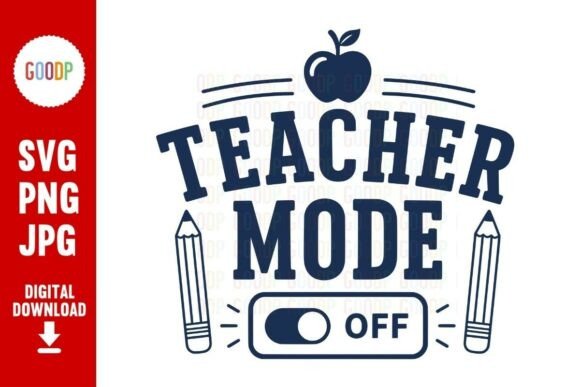
First impression? Teacher Mode off SVG lands with warm, approachable charm—not loud, not cutesy, not overly clever. It’s a clean, friendly illustration built around confident negative space and balanced proportions. The phrase “Teacher Mode Off” sits in a relaxed, rounded sans-serif that reads clearly at 3–4 inches wide, with subtle visual breathing room between letters and the surrounding graphic elements (a soft chalkboard icon, maybe a coffee cup or apple motif—though exact details depend on the file itself). As an embroidery designer who’s stitched hundreds of text-based graphics for small businesses and custom gifts, I immediately see its personality: calm authority meets lighthearted relief. It doesn’t shout “I’m on break!”—it whispers it, with intention.
Where It Shines: Real Projects, Real Customers
I tested Teacher Mode off SVG as the centerpiece for a custom embroidered cotton tote bag—intended for a local teacher appreciation pop-up shop. On medium-weight canvas, with a light tear-away stabilizer and 40-weight polyester thread, it stitched cleanly in under 90 seconds. The letterforms held crisp edges, corners stayed sharp, and the overall density felt generous without being heavy. That’s critical for tote bags meant to carry groceries, lesson plans, or weekend adventures—no puckering, no stiffness.
It also translated beautifully onto a unisex crewneck sweatshirt. Using cutaway stabilizer and slightly reduced stitch density (a quick edit in my embroidery software), the design retained its warmth without sinking into the fleece pile. Customers responded strongly—not just to the message, but to how finished it looked. No fuzzy edges. No lost detail. Just confident, wearable wit.
For baby items? I’d use it sparingly—and thoughtfully. A single-stitch version on a muslin burp cloth or organic cotton onesie works if scaled to 2.5 inches max and stitched with ultra-soft thread. But avoid dense fill areas on delicate newborn fabric; opt instead for a running-stitch outline or minimalist satin-stitch version (which means editing the original SVG first).
Where to Pause—and Plan Ahead
Teacher Mode off SVG is a strong illustration, not an embroidery file out of the box. That distinction matters. Since what you receive is an SVG, PNG, and JPG—not a native .pes, .dst, or .jef—your embroidery workflow starts with digitizing. If you’re new to that step, don’t skip it: auto-digitizing tools often overfill small letter counters or misjudge stitch direction on curved lines. I manually adjusted the “O” and “e” in “Mode” to prevent thread nesting, and softened the inner curve of the chalkboard icon to avoid skipped stitches on textured twill.
Be especially careful on stretchy fabrics like jersey tees or curved surfaces like caps. The original layout assumes flat, stable ground. For hats, reposition the text horizontally and reduce width by 10–15% to compensate for crown distortion. On dark fabric? Test contrast early—some versions of this design rely on thin outlines that disappear against charcoal or navy unless you boost stitch coverage or add a shadow layer.
And yes—check your license before listing Teacher Mode off SVG as part of a commercial embroidery service or digital product bundle. The listing says “You must have a cutting machine with software that is compatible with SVG files,” but says nothing about commercial embroidery rights. When in doubt, assume personal use only unless clarified by the seller.
What It Adds to Your Craft Business—Beyond the Stitch
This isn’t just another graphic. Teacher Mode off SVG carries emotional resonance. Teachers are tired. They’re seen—but rarely *seen* in a way that honors their humanity. That quiet shift from “on duty” to “off duty” lands with authenticity. When stitched onto a linen pillow cover for a retirement gift or a tea towel for a back-to-school boutique, it signals care—not just craft.
For Etsy sellers and handmade shop owners, that nuance builds trust. Buyers don’t just want legible text—they want proof that the maker considered context, wearability, and meaning. A well-executed Teacher Mode off SVG tells customers: “I understand your world. I chose this design because it fits yours.” That’s branding you can’t buy—it’s earned, one thoughtful stitch at a time.
Practical Designer Notes—Before You Hoop Up
- Always test first—on scrap fabric matching your final project’s weight and texture.
- Review stitch density in your digitizing software—especially in tight curves and inner letter shapes.
- Confirm hoop size compatibility; the full phrase may need scaling down for 4x4 hoops.
- Inspect small details at 200% zoom—look for stray nodes or overlapping paths in the SVG.
- Test black-and-white mockups to gauge contrast on light vs. dark backgrounds.
- Match stabilizer to fabric: cutaway for knits, tear-away for stable wovens, mesh for lightweight linens.
- Verify thread color harmony—this design shines in muted tones (sage, oatmeal, slate) but loses warmth in neon or metallics.
- Check dual-use viability: does it work equally well as a standalone embroidery file and a printable mockup for your Etsy listing?
Final Thought: A Small Graphic With Quiet Weight
Teacher Mode off SVG won’t dominate a tradeshow booth or trend on Pinterest overnight. But it will earn smiles from exhausted educators, thoughtful nods from gift shoppers, and repeat orders from boutique owners who value sincerity over sparkle. It’s a reminder that great design for embroidery isn’t about complexity—it’s about clarity, confidence, and knowing exactly where, and why, it belongs. Use it right, and it won’t just decorate fabric. It’ll hold space—for rest, for recognition, and for the real people behind the title.